
Anti-inflammatory, Flaxfarm, Remedies
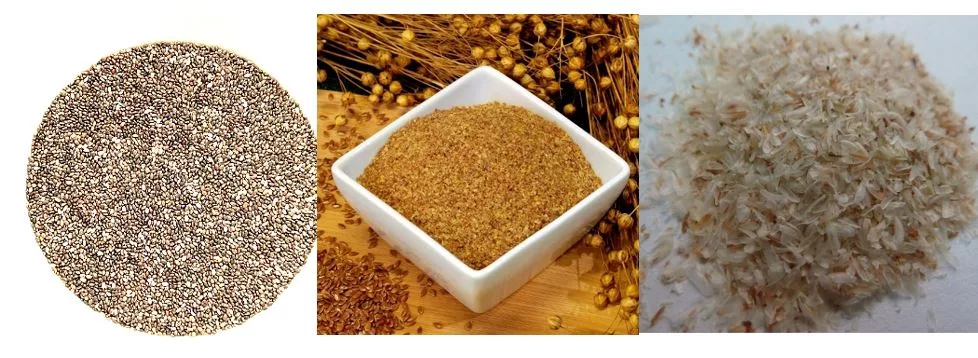
Psyllium, Flax or Chia?
What Eating Flax Feels Like
I’d always eaten what I thought of as a good diet with plenty of fruit and veg and had never had a digestive problem. I only started using ground flaxseed to help me lose weight, but the difference in my digestion within a couple of days was amazing. All I could think was, “this is how it’s meant to work.”
One of my regular flax porridge customers at Borough Market once summed it up perfectly to a friend:
“It makes you feel so clean…”
— accompanied by a downward sweep of her hands.
Crude, maybe, but biologically spot on.
Not all fibres behave the same in the gut
Some fibres mainly add bulk, some hold water, and some actively support gut signalling (i.e. the gut responding in the right way at the right time), mucus quality (one type of mucus protects the gut lining, another lubricates stools so they pass more easily), gut lining health, and resilience to dietary change including a degree of defence against pathogens.
Flax vs Psyllium vs Chia
Flax, psyllium husk, and chia are often grouped together as “high-fibre” digestive aids, but biologically they behave very differently and give different results, both short- and long-term.
They all soak up water, improve stool hydration, and aid regularity.
But a healthy colon, which is essential for whole-body health, needs to do more than simply go to the loo regularly.
A healthy gut is a finely tuned, responsive system that needs appropriate, multi-faceted support.
Flax (linseed): supports digestion in many ways
Flax isn’t just a fibre. It provides an unusually broad spectrum of gut-supporting components.
Flax provides:
-
Insoluble fibre – adds structure and gentle bulk
-
Soluble mucilage fibres – form a soft gel, feed microbes, and support the gut lining
-
Omega-3 fats – improve cell signalling and gut responsiveness
-
Lignans – microbial and epithelial modulators that support diversity
What really makes flax different is what happens when it meets the gut microbiome.
If you soak flaxseed, you’ll notice different types of “gloop” coming off it. These represent different soluble fibre fractions, each fermented by different microbes and at different speeds. Together, they generate a balanced range of short-chain fatty acids (SCFAs), including butyrate, propionate, and acetate, each with specific roles in supporting gut lining health, mucus production, and whole-body metabolism.
Flax therefore:
-
Supports balanced SCFA signalling
-
Improves goblet cell responsiveness
-
Supports mucus quality, not just quantity
-
Enhances natural stool lubrication (“glide”)
-
Improves microbiome diversity, aiding digestive resilience and adaptability
Because flax delivers variety — structurally and biochemically — it helps prepare the gut to cope better with different foods and dietary changes.
This is why flax often works when other “similar” fibres don’t. It helps the gut respond better, not just push things through.
Psyllium husk: mechanical reliability
Psyllium isn’t really a food, but it is an excellent source of almost pure gel-forming fibre that helps get things moving. It is good at what it does but what it does is almost entirely mechanical, with few of the broader benefits found in whole seeds.
-
Absorbs water and forms a gel that bulks up stool
-
Stimulates bowel movement via the stretch reflex
That makes it useful for short-term constipation relief and for supporting regularity when gut signalling is impaired. Psyllium is only minimally fermentable, so it contributes very little to short-chain fatty acid production. As a result, it doesn’t actively support mucus quality, gut lining function, or long-term microbiome health and diversity.
In short, psyllium helps you go to the loo, and it’s good at that but that’s about all it does.
Chia: hydration and viscosity
Chia sits somewhere between flax and psyllium. It’s a real food that provides fibre, soluble fibre, and omega-3s.
-
Absorbs water and forms a gel
-
Adds moisture and viscosity
-
Provides some omega-3
However:
-
Its fermentation profile is narrower
-
Fewer SCFAs are produced
-
Support for gut lining signalling is weaker
Chia supports hydration and bulk but offers less long-term adaptive benefit than flax, and less protection against pathogens.
Differences between flax, psyllium and chia for digestive support
At a glance:
| Feature | Flax | Psyllium | Chia |
|---|---|---|---|
| Stool hydration | Strong | Strong | Moderate |
| Feeding good microbes | Strong | Minimal | Moderate |
| SCFA signalling | Broad & strong | Minimal | Narrow |
| Mucus quality & stool lubrication | Strong | Weak | Moderate |
| Long-term resilience | Strong | Weak | Moderate |
Suggestions to support digestive health
Psyllium, flax or chia?
It isn’t an either/or situation. The more different fibre-rich foods you include, the healthier your digestion tends to be. However, scientific studies show that flax plays a unique role because of its wide range of gut-friendly elements.
Psyllium
If you already use psyllium and it works for you, there’s no need to stop. It can be very helpful in the early stages of improving digestion, particularly if things slow down or regularity becomes an issue.
As you add more fibre-rich foods and dietary variety, you may find you rely less on psyllium over time. It’s useful to keep some in the cupboard for occasional use, especially during periods of stress, travel, or dietary disruption.
Flax
For establishing long-term gut health, ground flaxseed is hard to beat. Think prevention rather than cure.
It works best as a daily food. Add it to smoothies, sprinkle it on breakfast or desserts, stir it into yoghurt, soups, stews, or even baked beans. Aim for 1–2 tablespoons of ground flaxseed once or twice a day. Bronze or golden flax both work well and many people enjoy using a mix of the two.
Flax Farm porridges and mueslis provide a generous helping of ground flaxseed with other gut-friendly ingredients in every bowlful. Flaxjacks are exceptionally gut-friendly bars, ideal for children or for those who need breakfast on the go.
Because flax supports hydration, movement, signalling, and gut lining health all at once, it helps digestion feel more natural, comfortable, and resilient, not just regular.
Chia
Chia definitely deserves a place in a modern diet. Many of us simply don’t eat enough fibre, and adding a wider variety of nuts and seeds is a good thing.
Chia puddings, sprinkling seeds on breakfast or into smoothies, and recipes that include chia can support hydration and add gentle bulk. While it doesn’t offer the same breadth of gut support as flax, it contributes useful variety, which is good.
A simple way to think about it
-
Psyllium helps you go
-
Chia supports hydration and adds fibre variety
-
Flax helps you go and gives the gut what it needs to work better overall
👉 We might be biased but a lot of people agree that you should choose ground flaxseed as your number one gut health aid.
Chia Image credit: © Frank C. Müller, via Wikimedia Commons.
Licensed under Creative Commons Attribution-ShareAlike 4.0 International (CC BY-SA 4.0).
This image has been modified.
https://creativecommons.org/licenses/by-sa/4.0/
Psylium Image credit: GNU Head, via Wikimedia Commons.
Licensed under the GNU Free Documentation License v1.2 or later (GFDL) and Creative Commons Attribution-ShareAlike 3.0 Unported (CC BY-SA 3.0).
This image has been modified.
CC BY-SA 3.0: https://creativecommons.org/licenses/by-sa/3.0/
GFDL: https://www.gnu.org/licenses/fdl-1.2.html
Create an account to get access and updates when we post new content
Register here